
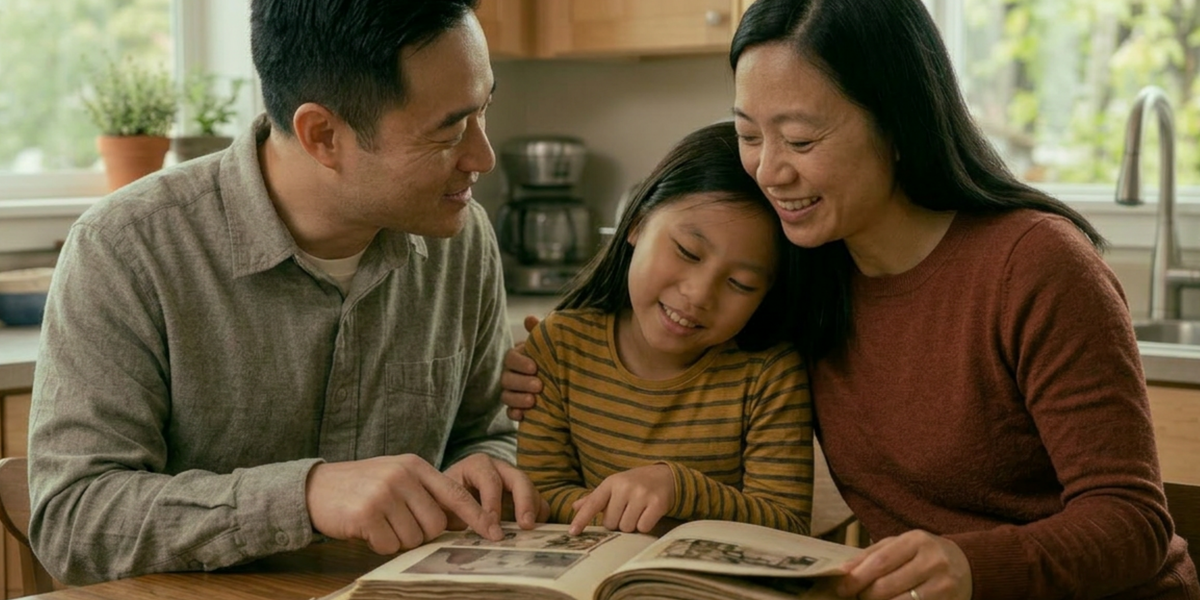
Exploring resilience, relationships, and intergenerational care in AAPI family life.
Asian American and Pacific Islander (AAPI) Heritage Month is an opportunity to honor the long, complex, and deeply influential history of AAPI communities in the United States. May was chosen for this observance in part to commemorate the arrival of one of the first Japanese immigrants to the U.S. in May 1843 and the completion of the Transcontinental Railroad in May 1869, a project made possible in large part by Chinese laborers.
What followed, however, was not a simple story of opportunity. AAPI history in the U.S. has also been shaped by exclusion, violence, and erasure, from the Chinese Exclusion Act to the incarceration of Japanese Americans during World War II. And yet, across generations, AAPI communities have continued to build families, businesses, neighborhoods, scholarship, art, and social movements that have profoundly shaped American life.
Today, AAPI communities are among the fastest growing and most diverse populations in the country. AAPI communities are not a monolith; they encompass tremendous diversity in ethnicity, language, migration history, religion, socioeconomic status, and family structure. Recognizing that diversity matters in mental health care, because culturally responsive therapy begins with understanding that no single narrative can speak for all Asian American, Native Hawaiian, or Pacific Islander individuals and families.
Awareness of Asian American Fathers
This month also invites us to pay closer attention to stories that are too often overlooked, including those of Asian American fathers. Public narratives have often flattened Asian and immigrant fathers into stereotypes: distant, overly strict, emotionally reserved, or defined primarily by work and sacrifice. But research increasingly shows a much more nuanced picture.
Asian American and immigrant fathers often parent within the tension of migration, racism, language shifts, changing gender expectations, and intergenerational cultural negotiation. At the same time, many fathers are actively engaged in preserving and rewriting their parent-child scripts.
In addition to protecting, providing, and teaching, they are also observing, adapting, bridging, and growing with their children, even when structural pressures and cultural transitions make that role harder to enact in ways that are immediately recognized by mainstream U.S. frameworks.
Family Relationships, Resilience, and Intergenerational Care
My work and the broader literature both point to the resilience of Asian American fathers not as the absence of struggle, but as the ongoing effort to stay present, adapt, and care within complex family and social realities.
Emerging research on Asian American families highlights how parenting is shaped by acculturation gaps, discrimination, bicultural socialization, and family relationships, while also underscoring strengths such as familism, commitment, and intergenerational care.
In my own research with immigrant fathers, we have seen how deeply many fathers want to be known not only as providers, but as emotionally meaningful, relationally engaged parents.
During AAPI Month, we celebrate not only the history and contributions of AAPI communities, but also the quieter forms of courage that happen every day within families: the effort to negotiate between cultures, nurture connection, and create new possibilities for the next generation.